How I design an ornamental tattoo around the body
By Jenna at Golden Hour Tattoo · Published August 18, 2026 · Updated August 30, 2026
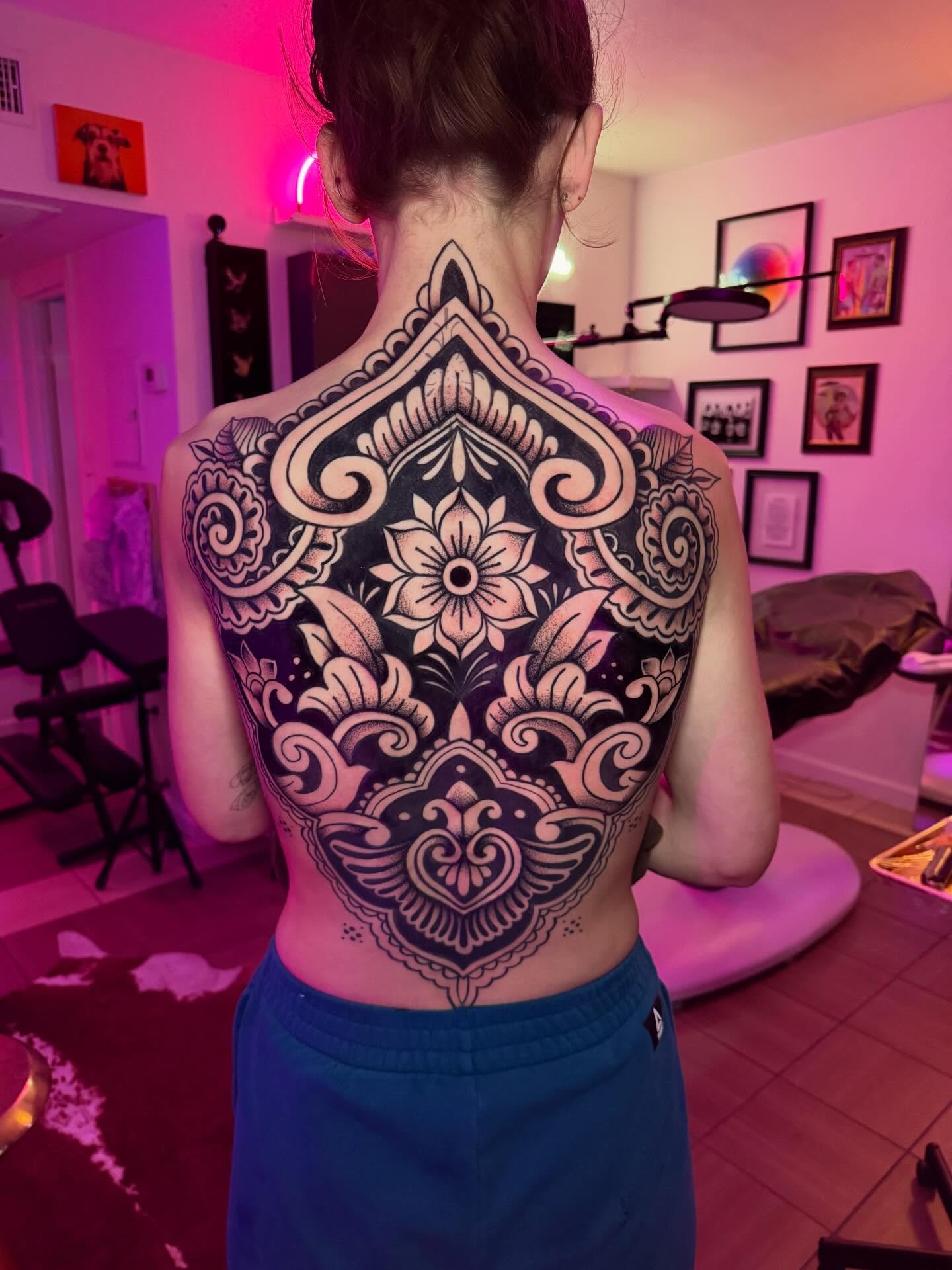
The most common thing I get sent is a flat image of a pattern someone loves. I understand why. It is easy to picture. The problem is that a flat pattern does not know your body, and a tattoo has to.
I start with the anatomy
Before I draw anything I want to see the area in person or in clear photos from several angles. I am looking for where the muscle sits, where the skin folds, and where the shape naturally narrows.
Those points tell me where a pattern can be dense and where it needs to open up. Density in the wrong place is what makes ornamental work look stuck on rather than grown into.
The center line decides everything
Ornamental work needs an axis. On a back it is the spine. On a leg it is the shin or the outer seam. Once I choose that line, every ring, arc, and mirrored element gets measured against it.
If the axis is even slightly off, the whole piece feels wrong from a distance even when each element is clean. This is the part of the process I am slowest about on purpose.
Negative space is part of the drawing
I decide what stays skin before I decide what goes black. Open space is what gives a piece its silhouette, and silhouette is what you actually see across a room.
Planning for how it ages
- Heavier outer line, lighter interior detail, so the shape survives softening
- Space between fine elements so they do not merge over the years
- Edges left open where the project might extend later
If you are thinking about starting something ornamental, send me the placement and the feeling you are after. The design does not need to be solved before we talk.